
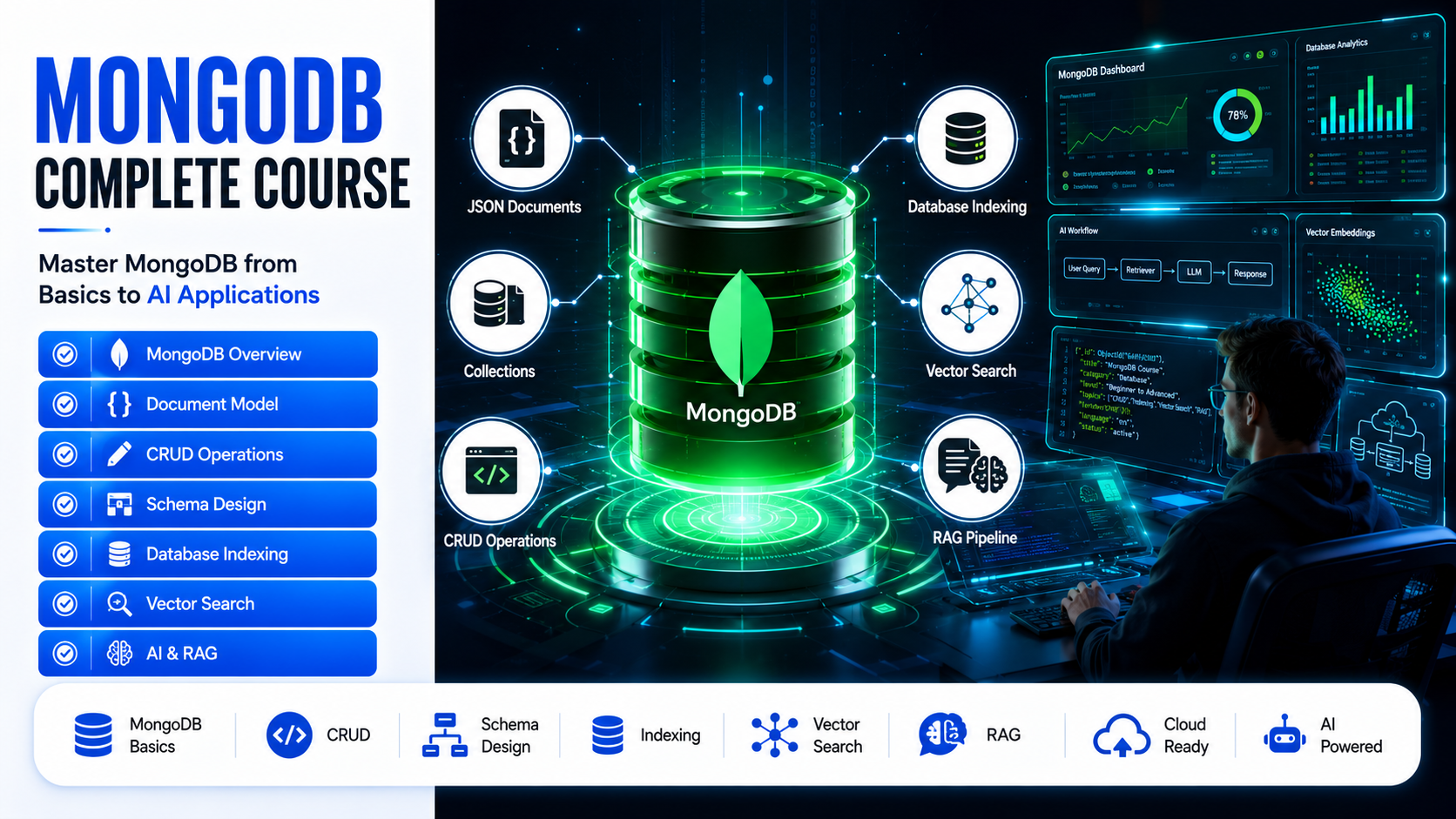
Master MongoDB Complete Course from the ground up with this complete course covering document models, CRUD operations, indexing, vector search, schema design, and RAG applications.
MongoDB Complete Course & Learn Modern Database Development from Scratch
Modern applications generate an enormous amount of data every second. Whether it’s an e-commerce platform processing customer orders, a streaming service tracking user preferences, or an AI chatbot retrieving information in real time, the ability to manage data efficiently has become one of the most valuable skills in software development.
For many years, relational databases such as MySQL and PostgreSQL dominated the industry. They continue to play an important role, but as applications became more dynamic, developers needed a database that could adapt to constantly changing requirements without forcing every piece of information into rigid tables.
That’s where MongoDB changed the landscape.
Instead of storing information in rows and columns, MongoDB uses flexible documents that closely resemble the objects developers already work with in programming languages. This simple idea makes application development faster, easier to maintain, and significantly more scalable.
Today, MongoDB powers thousands of applications across industries including healthcare, finance, gaming, education, logistics, and artificial intelligence. Companies like Adobe, eBay, Bosch, and many technology startups rely on MongoDB because it allows them to move quickly without sacrificing performance.
This course has been carefully designed to take you from the fundamentals of MongoDB to modern AI-powered implementations such as Vector Search and Retrieval-Augmented Generation (RAG). Instead of simply memorizing commands, you’ll understand why each concept exists, when to use it, and how it solves real-world development challenges.
Whether you’re an aspiring backend developer, a full-stack engineer, a DevOps professional, or someone curious about modern databases, this course will give you a practical understanding of MongoDB that extends beyond documentation and tutorials.
🚀 Register Now and Start Your Journey to Becoming a MongoDB Certified Developer!
MongoDB Overview
Before learning queries or writing code, it’s important to understand what MongoDB actually is and why it has become one of the world’s most popular NoSQL databases.
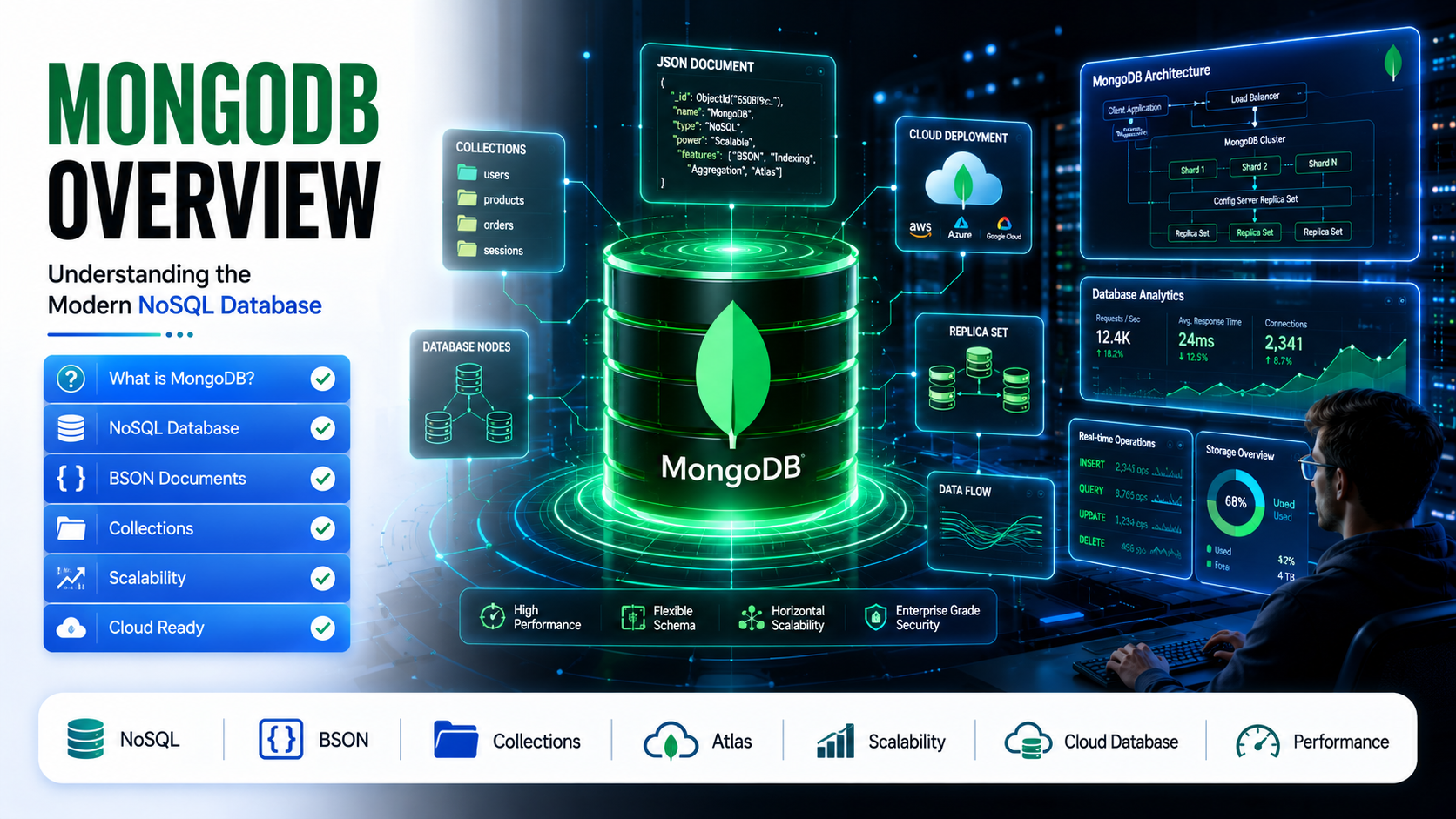
At its core, MongoDB is a document-oriented database. Unlike traditional databases that organize information into rows and columns, MongoDB stores data as JSON-like documents using BSON (Binary JSON). These documents can contain nested objects, arrays, and fields with different structures.
Imagine you’re building an online shopping platform.
In a traditional SQL database, customer information, addresses, orders, payment details, and shopping carts are often separated into multiple tables. Retrieving a customer’s complete profile usually requires joining several tables together.
MongoDB approaches this differently.
A customer document can contain personal information, addresses, recent orders, and preferences inside a single document. Because related data is stored together, applications often require fewer database operations, leading to better performance for many workloads.
Another reason developers appreciate MongoDB is its flexibility.
Real-world applications evolve constantly. A startup might launch with only basic user information but later decide to store profile pictures, social media links, preferences, achievements, or subscription details. In a relational database, these changes often require schema migrations and downtime.
MongoDB allows documents in the same collection to contain different fields when necessary, making development significantly more agile.
This flexibility doesn’t mean data becomes disorganized. MongoDB provides powerful validation rules that allow developers to maintain consistency while still enjoying a more adaptable structure.
Scalability is another defining characteristic.
As applications grow, handling millions of users becomes increasingly difficult. MongoDB was designed with horizontal scaling in mind. Instead of upgrading a single powerful server, developers can distribute data across multiple machines using sharding, enabling applications to continue performing efficiently even under heavy traffic.
MongoDB also includes features such as:
- Automatic replication for high availability
- Built-in indexing for faster queries
- Aggregation framework for analytics
- Full-text search capabilities
- Geospatial queries
- Time-series collections
- Vector Search for AI applications
These capabilities allow MongoDB to support everything from simple websites to enterprise-scale cloud applications.
It’s important to understand that MongoDB is not intended to replace relational databases entirely. Financial systems requiring strict ACID relationships may still benefit from SQL databases. MongoDB excels when flexibility, scalability, and rapid development are higher priorities.
Learning MongoDB isn’t simply about understanding another database—it’s about adopting a different mindset for designing modern applications.
Relational to Document Model
One of the biggest adjustments developers make when learning MongoDB is shifting from relational thinking to document-oriented thinking.
If you’ve worked with MySQL or PostgreSQL, you’re familiar with normalization. Information is divided into multiple related tables to eliminate redundancy and maintain consistency.
Consider a university management system.
In a relational database, students, courses, enrollments, instructors, departments, and grades are stored separately. Relationships connect these tables using primary and foreign keys.
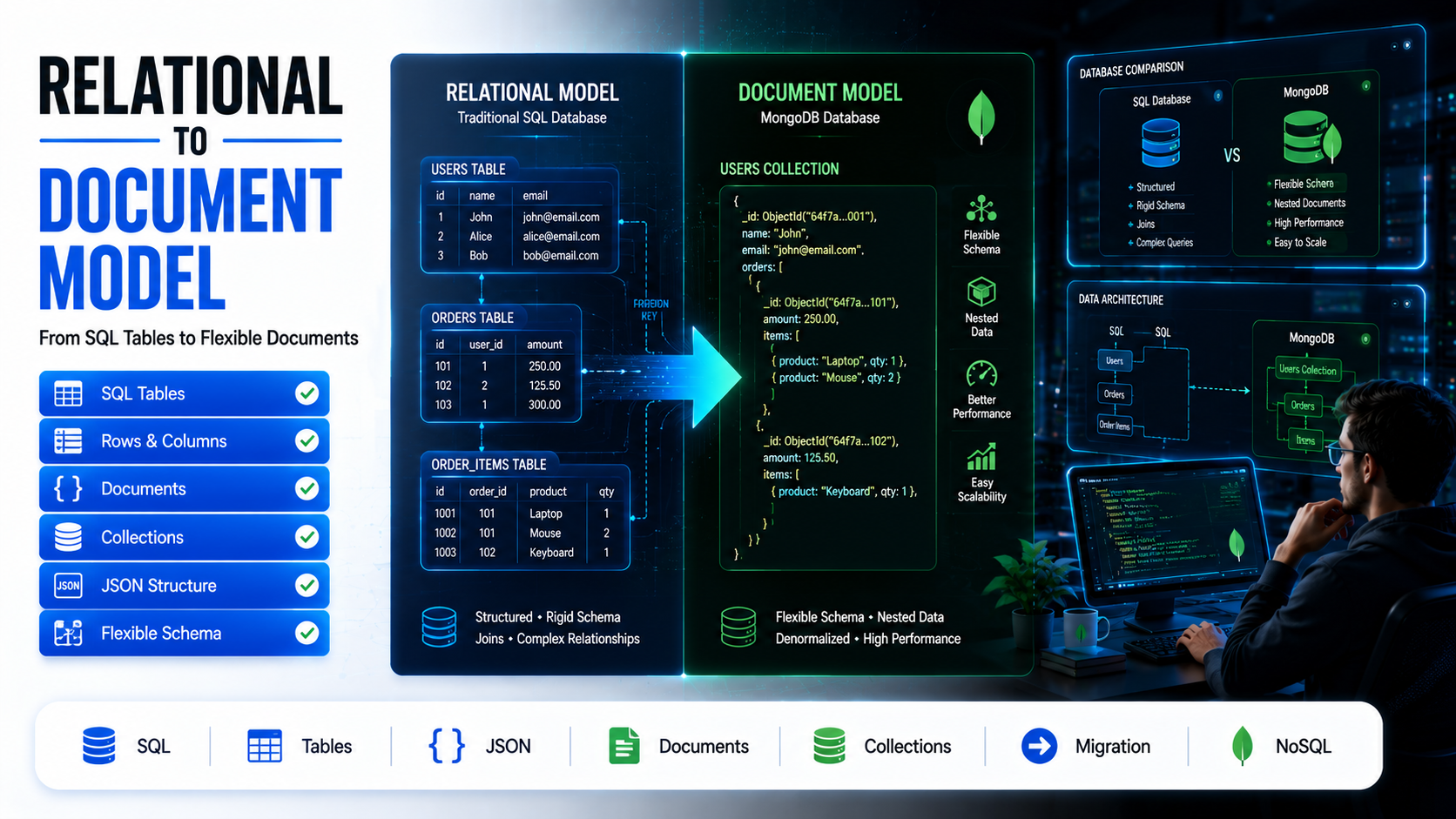
Whenever the application needs complete student information, it performs several JOIN operations.
This design is elegant for highly structured systems but can become increasingly complex as applications grow.
MongoDB encourages a different approach.
Instead of spreading related information across numerous tables, MongoDB groups data that is frequently accessed together into a single document.
For example, instead of creating separate tables for customers and shipping addresses, a MongoDB document may contain:
- Customer details
- Contact information
- Multiple shipping addresses
- Wishlist
- Recent purchases
- Shopping preferences
Because everything lives inside one document, retrieving customer information often requires only one query.
This significantly improves performance in applications where related information is frequently requested together.
However, moving from SQL to MongoDB isn’t about embedding everything.
Developers must decide between embedding documents and referencing documents.
Embedding works best when:
- Data belongs exclusively to one parent.
- Child information is frequently accessed.
- Child records remain relatively small.
Referencing works better when:
- Data is shared across multiple entities.
- Documents become too large.
- Relationships frequently change.
Choosing between embedding and referencing is one of the most important architectural decisions in MongoDB.
A common mistake among beginners is trying to recreate SQL tables inside MongoDB.
Although technically possible, this defeats many of MongoDB’s strengths.
Instead, developers should begin by analyzing how the application accesses information rather than how the information is stored.
MongoDB schema design is query-driven.
Rather than asking, “How should I normalize this data?” developers ask, “What information does my application need most often?”
This small shift fundamentally changes database design.
Understanding this philosophy early makes every advanced MongoDB topic much easier to grasp.
Schema Design Patterns and Anti-patterns
Schema design is one of the most important skills in MongoDB development.
Although MongoDB provides flexibility, that flexibility should never be confused with a lack of planning.
A well-designed schema can improve performance, reduce storage costs, simplify application logic, and support future scalability.
A poorly designed schema can create slow queries, oversized documents, unnecessary duplication, and difficult maintenance.
Experienced MongoDB developers don’t randomly choose document structures. Instead, they rely on proven schema design patterns.
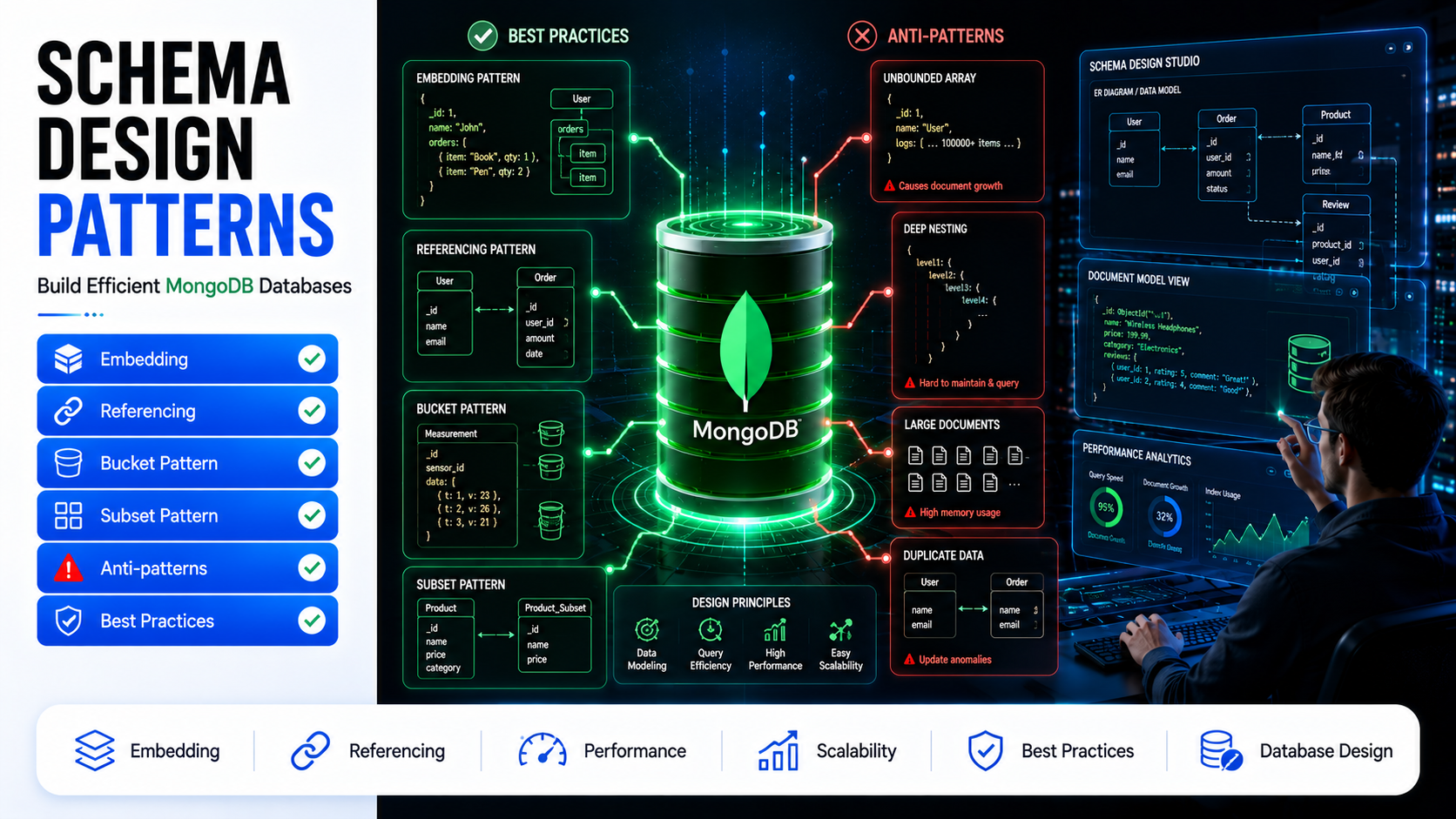
One widely used pattern is the Embedded Document Pattern. When related information always belongs to a single parent entity, embedding simplifies queries and reduces the need for multiple database operations. A blog post containing comments, tags, and metadata is a good example where embedding can be highly effective, provided the comment volume remains manageable.
Another useful approach is the Reference Pattern, where related data is stored separately and linked through identifiers. This is especially helpful when multiple entities share the same information, such as products belonging to several categories or employees assigned to different projects.
The Bucket Pattern groups similar records together, making it ideal for time-series data like IoT sensor readings or application logs. Instead of storing millions of tiny documents, related entries are collected into larger buckets, improving storage efficiency and query performance.
For applications dealing with large media files or extensive text, developers often use the Subset Pattern. Frequently accessed information remains in the primary document, while less commonly used content is stored elsewhere and loaded only when necessary. This keeps everyday queries fast without sacrificing access to detailed information.
Just as important as good patterns are the anti-patterns developers should avoid. One common mistake is creating excessively large documents by embedding unlimited child records, such as thousands of comments inside a single blog post. MongoDB documents have a size limit, and oversized documents become slower to update and transfer.
Another anti-pattern is duplicating data without a clear strategy for keeping it synchronized. While controlled duplication can improve performance, uncontrolled duplication often leads to inconsistent information across the application.
Trying to mimic a relational database by creating numerous collections connected through application-side joins is another frequent error. Although MongoDB supports references, overusing them can eliminate many of the performance advantages that document databases provide.
Good schema design isn’t about following rigid rules—it’s about understanding how your application reads and writes data. A thoughtful schema reflects real user behavior, minimizes unnecessary operations, and remains flexible enough to accommodate future growth without major redesigns.
CRUD Operations in MongoDB
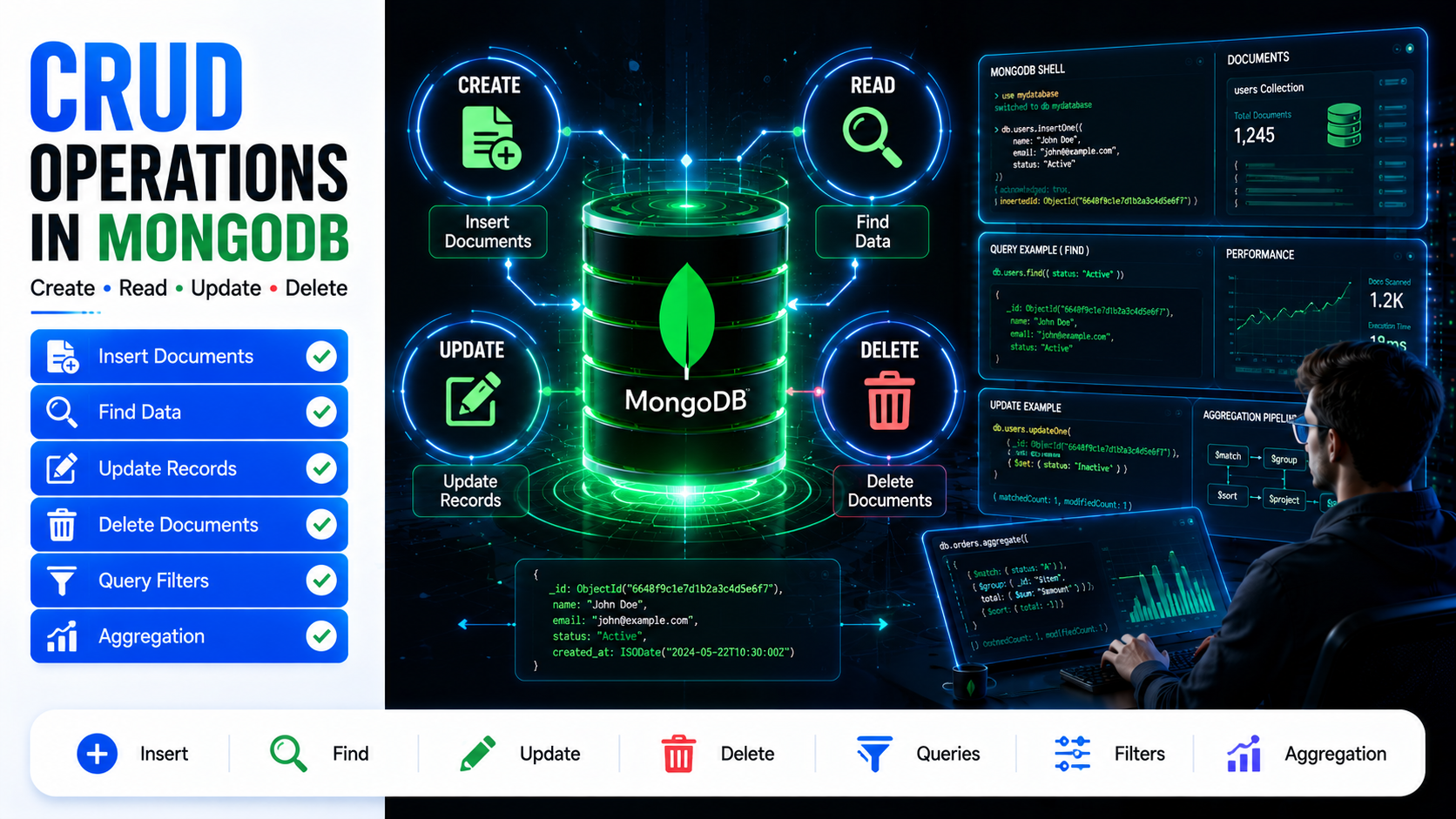
Once you’ve designed your database schema, the next step is learning how to interact with the data stored inside it. Every database-driven application, whether it’s a banking system, an e-commerce platform, or a social media app, performs four basic operations countless times throughout the day: Create, Read, Update, and Delete. Collectively, these are known as CRUD operations.
In MongoDB, CRUD operations are designed to be intuitive because they work directly with documents rather than rows in a table. Instead of thinking in terms of records spread across multiple tables, developers work with complete objects that closely resemble the data structures used in modern programming languages.
The first operation, Create, is all about inserting new documents into a collection. Imagine you’re building a user registration system. Every time a new person signs up, MongoDB stores their information as a document containing details such as their name, email address, profile information, and account settings. Unlike relational databases, MongoDB doesn’t require every document to have exactly the same fields. This flexibility allows applications to evolve naturally without forcing developers to redesign the entire database every time a new feature is introduced.
The second operation, Read, is the foundation of every application. Whenever users log in, search for products, browse articles, or view their profile, the application retrieves information from MongoDB. What makes MongoDB particularly powerful is its ability to search documents using filters, comparison operators, logical conditions, and aggregation pipelines. Instead of simply fetching all records, developers can retrieve exactly the information users need while keeping response times fast.
For example, an online shopping platform might search for all products under a certain price range, belonging to a specific category, and currently in stock. MongoDB allows these filters to be combined efficiently, making data retrieval both flexible and highly optimized.
The third operation, Update, becomes important whenever existing information changes. Customers update their shipping addresses, employees modify their profiles, or administrators change product prices. Rather than replacing an entire document every time, MongoDB lets developers update only the specific fields that have changed. This reduces unnecessary data transfer and improves overall efficiency.
One of MongoDB’s strengths is its support for atomic updates at the document level. This means changes made to a single document either complete successfully or don’t happen at all, helping maintain data consistency even when multiple users interact with the database simultaneously.
Finally, Delete removes information that is no longer needed. This could involve deleting inactive accounts, removing expired sessions, or cleaning outdated log records. Although deleting data sounds simple, experienced developers approach it carefully. In many production systems, records are “soft deleted” by marking them as inactive instead of removing them permanently. This approach preserves historical information while keeping it hidden from everyday users.
Beyond these four basic operations, MongoDB provides additional capabilities that make application development much easier. Developers can insert multiple documents in bulk, update thousands of records using conditions, perform upserts that insert data if it doesn’t already exist, and execute transactions when multiple operations must succeed together.
Another important aspect of CRUD operations is error handling. Applications should never assume that every database request will succeed. Network interruptions, duplicate values, validation failures, or permission issues can all cause operations to fail. Proper exception handling ensures users receive meaningful feedback while preventing data corruption.
As projects become larger, CRUD operations form the backbone of APIs, backend services, and microservices. Whether you’re using Node.js, Python, Java, Go, or C#, nearly every request your application processes will eventually translate into one or more MongoDB CRUD operations.
Understanding CRUD isn’t just about memorizing commands—it’s about learning how applications communicate with data. Once this concept becomes second nature, building scalable backend systems becomes significantly easier.
Indexing Design Fundamentals
As databases grow, finding information becomes increasingly challenging. Searching through a collection containing a few hundred documents is quick, but searching millions of records without optimization can dramatically slow down an application. This is where indexing becomes one of MongoDB’s most valuable features.
To understand indexing, imagine a library with thousands of books. If the books weren’t organized in any way, finding a single title would require checking every shelf one by one. Now imagine the library has a catalog arranged alphabetically. Instead of searching every book, you simply look up the title and immediately know where to find it.
MongoDB indexes work in much the same way. They create an organized structure that allows the database to locate documents far more efficiently than scanning every record in a collection.
Without an index, MongoDB performs what’s known as a collection scan. It checks every document until it finds matching data. While this approach works for small datasets, performance declines rapidly as collections grow larger.
Creating an index on frequently searched fields allows MongoDB to jump directly to matching documents, significantly reducing query execution time.
Choosing the right fields for indexing is just as important as creating indexes themselves. Fields that users search frequently, such as email addresses, usernames, product categories, or order IDs, are ideal candidates because they are commonly used in filters and lookups.
However, indexing isn’t something developers should do indiscriminately. Every index consumes additional storage space and slightly increases the time required for insert and update operations because MongoDB must maintain the index whenever data changes.
This is why experienced database engineers focus on balanced indexing rather than indexing every field.
MongoDB supports several types of indexes, each designed for specific scenarios.
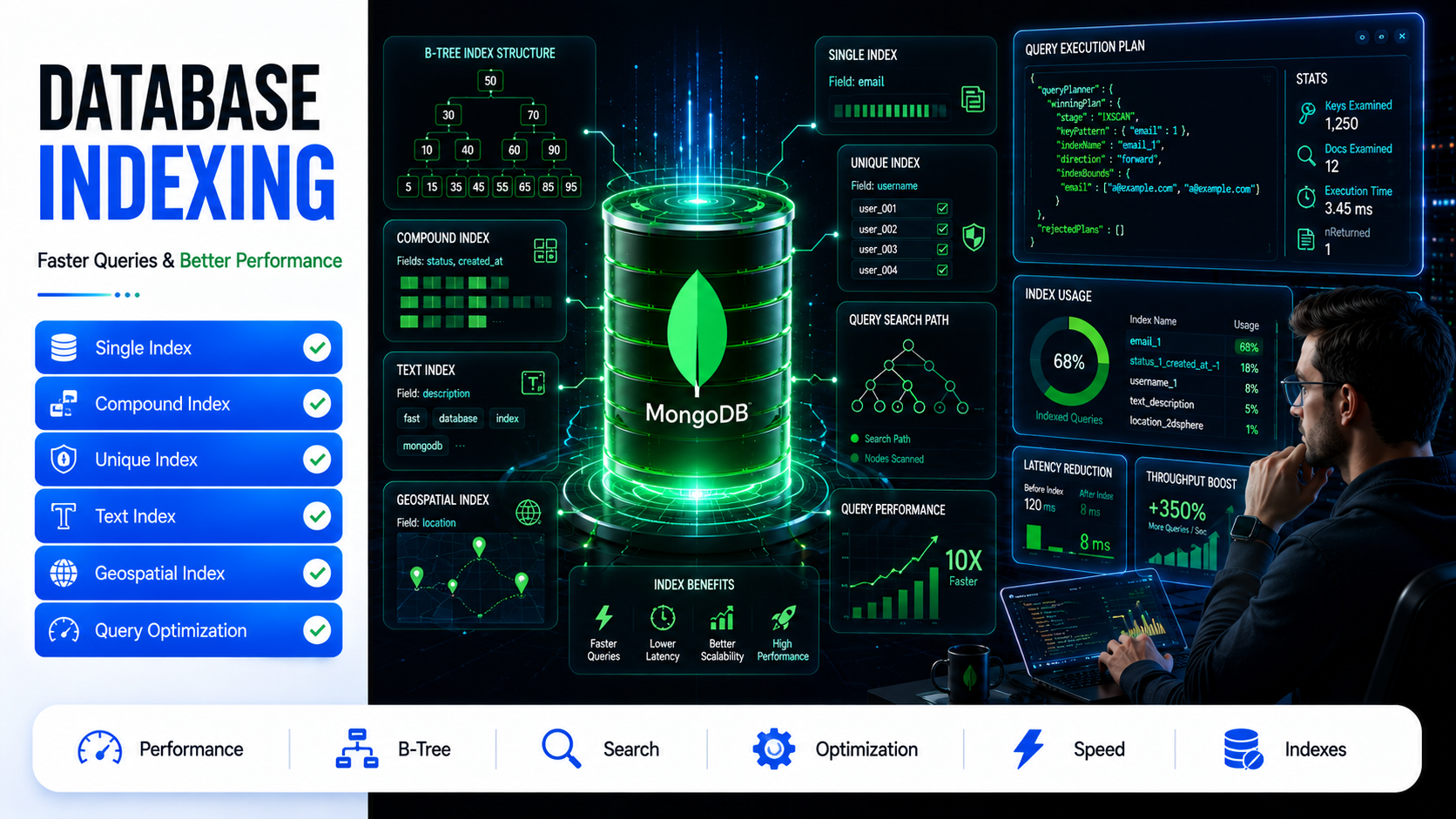
A Single Field Index improves searches on one field, such as a customer’s email address.
A Compound Index combines multiple fields into a single index, making it useful when queries regularly filter by more than one condition. For example, an e-commerce application might frequently search by category and price together.
A Unique Index prevents duplicate values, making it ideal for usernames, email addresses, employee IDs, or product SKUs.
Applications involving maps or location-based services often rely on Geospatial Indexes, allowing developers to search for nearby restaurants, delivery drivers, or stores within a specified radius.
Modern AI-powered applications also benefit from specialized indexing strategies that support semantic search and vector similarity, topics that become especially important in the next module.
Monitoring index performance is equally important. Over time, applications evolve, user behavior changes, and queries become more complex. MongoDB provides tools that help developers analyze query execution plans, identify slow operations, and determine whether existing indexes remain effective.
One common mistake among beginners is creating duplicate or unnecessary indexes. Although indexes improve read performance, excessive indexing wastes storage and can actually reduce write performance. Regular maintenance ensures the database remains efficient as it scales.
Ultimately, indexing isn’t about making every query faster—it’s about making the right queries faster. A carefully planned indexing strategy can dramatically improve user experience, reduce server load, and support applications handling millions of requests every day.
As databases grow, finding information becomes increasingly challenging. Searching through a collection containing a few hundred documents is quick, but searching millions of records without optimization can dramatically slow down an application. This is where indexing becomes one of MongoDB’s most valuable features.
To understand indexing, imagine a library with thousands of books. If the books weren’t organized in any way, finding a single title would require checking every shelf one by one. Now imagine the library has a catalog arranged alphabetically. Instead of searching every book, you simply look up the title and immediately know where to find it.
MongoDB indexes work in much the same way. They create an organized structure that allows the database to locate documents far more efficiently than scanning every record in a collection.
Without an index, MongoDB performs what’s known as a collection scan. It checks every document until it finds matching data. While this approach works for small datasets, performance declines rapidly as collections grow larger.
Creating an index on frequently searched fields allows MongoDB to jump directly to matching documents, significantly reducing query execution time.
Choosing the right fields for indexing is just as important as creating indexes themselves. Fields that users search frequently, such as email addresses, usernames, product categories, or order IDs, are ideal candidates because they are commonly used in filters and lookups.
However, indexing isn’t something developers should do indiscriminately. Every index consumes additional storage space and slightly increases the time required for insert and update operations because MongoDB must maintain the index whenever data changes.
This is why experienced database engineers focus on balanced indexing rather than indexing every field.
MongoDB supports several types of indexes, each designed for specific scenarios.
A Single Field Index improves searches on one field, such as a customer’s email address.
A Compound Index combines multiple fields into a single index, making it useful when queries regularly filter by more than one condition. For example, an e-commerce application might frequently search by category and price together.
A Unique Index prevents duplicate values, making it ideal for usernames, email addresses, employee IDs, or product SKUs.
Applications involving maps or location-based services often rely on Geospatial Indexes, allowing developers to search for nearby restaurants, delivery drivers, or stores within a specified radius.
Modern AI-powered applications also benefit from specialized indexing strategies that support semantic search and vector similarity, topics that become especially important in the next module.
Monitoring index performance is equally important. Over time, applications evolve, user behavior changes, and queries become more complex. MongoDB provides tools that help developers analyze query execution plans, identify slow operations, and determine whether existing indexes remain effective.
One common mistake among beginners is creating duplicate or unnecessary indexes. Although indexes improve read performance, excessive indexing wastes storage and can actually reduce write performance. Regular maintenance ensures the database remains efficient as it scales.
Ultimately, indexing isn’t about making every query faster—it’s about making the right queries faster. A carefully planned indexing strategy can dramatically improve user experience, reduce server load, and support applications handling millions of requests every day.
Vector Search Fundamentals
Artificial Intelligence has transformed how people search for information. Traditional databases are excellent at finding exact matches, but modern users often expect search systems to understand meaning rather than just keywords.
Consider someone searching an online knowledge base for “How can I reduce server response time?” Another user might search for “Ways to improve application performance.” Although the wording is different, both users are looking for similar information.
A traditional keyword search may treat these as separate queries. Vector Search attempts to understand that they express nearly the same intent.
This is where vector embeddings become important.
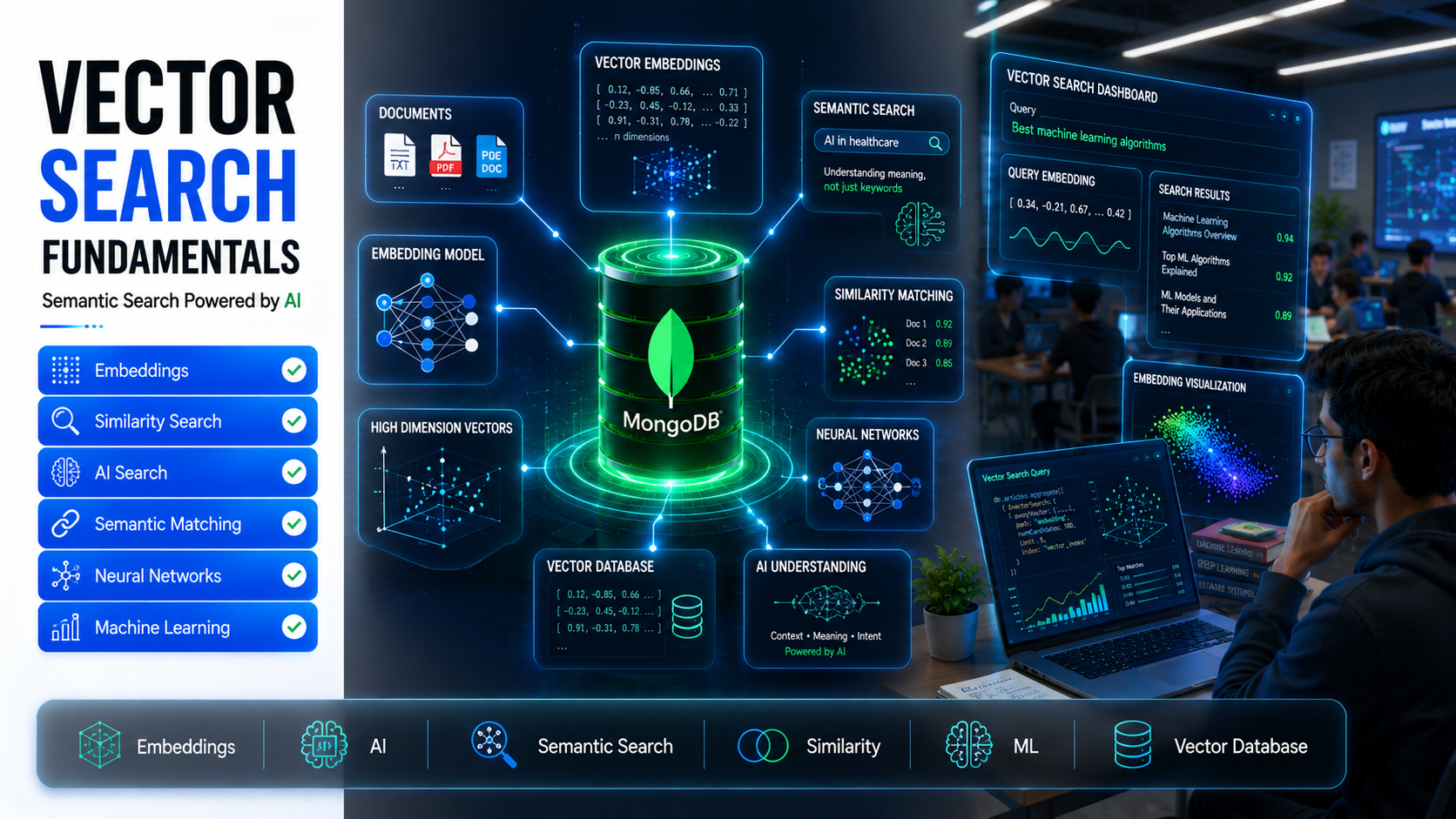
Instead of storing text as ordinary words, AI models convert text into numerical representations called vectors. These vectors capture semantic meaning, allowing similar ideas to exist close together in mathematical space.
MongoDB’s Vector Search feature enables developers to store these embeddings alongside their application data and perform similarity searches directly inside the database.
This capability has become increasingly valuable as organizations build AI-powered products such as intelligent search engines, recommendation systems, document assistants, customer support bots, and enterprise knowledge platforms.
Imagine an employee searching an internal documentation portal.
Rather than requiring exact keyword matches, Vector Search identifies documents whose meaning closely resembles the user’s question. Even if different terminology is used, relevant results can still appear.
This dramatically improves the user experience because people naturally express the same idea in different ways.
Vector Search also plays a significant role in recommendation systems. Streaming platforms recommend movies with similar themes, e-commerce websites suggest related products, and learning platforms recommend courses aligned with previous interests. These recommendations rely on measuring similarity between vectors instead of relying solely on categories or tags.
Implementing Vector Search involves several stages. First, text, images, or other content are processed using an embedding model. The resulting vectors are stored within MongoDB. When a user submits a query, that query is converted into another vector, and MongoDB searches for documents whose vectors are mathematically closest to the query.
The result is a search experience based on meaning rather than literal wording.
Despite its advantages, Vector Search should not completely replace traditional search. Exact lookups, filtering, sorting, and structured queries are still better suited to conventional database operations. In practice, many modern applications combine keyword search, metadata filtering, and vector similarity to produce the most accurate and relevant results.
Understanding Vector Search provides an essential foundation for the final module, where these concepts are combined with large language models to build Retrieval-Augmented Generation (RAG) systems. Rather than allowing AI models to rely only on their pre-trained knowledge, RAG enables them to retrieve fresh, relevant information from MongoDB before generating responses. This combination creates AI applications that are more accurate, context-aware, and capable of working with up-to-date information.
RAG with MongoDB
Artificial Intelligence has evolved rapidly over the last few years, but even the most advanced Large Language Models (LLMs) have one significant limitation—they only know what they were trained on. If you ask an AI model about your company’s internal documentation, recently published research, or private business data, it simply doesn’t have access to that information unless it’s provided during the conversation.
This challenge is exactly what Retrieval-Augmented Generation (RAG) is designed to solve.
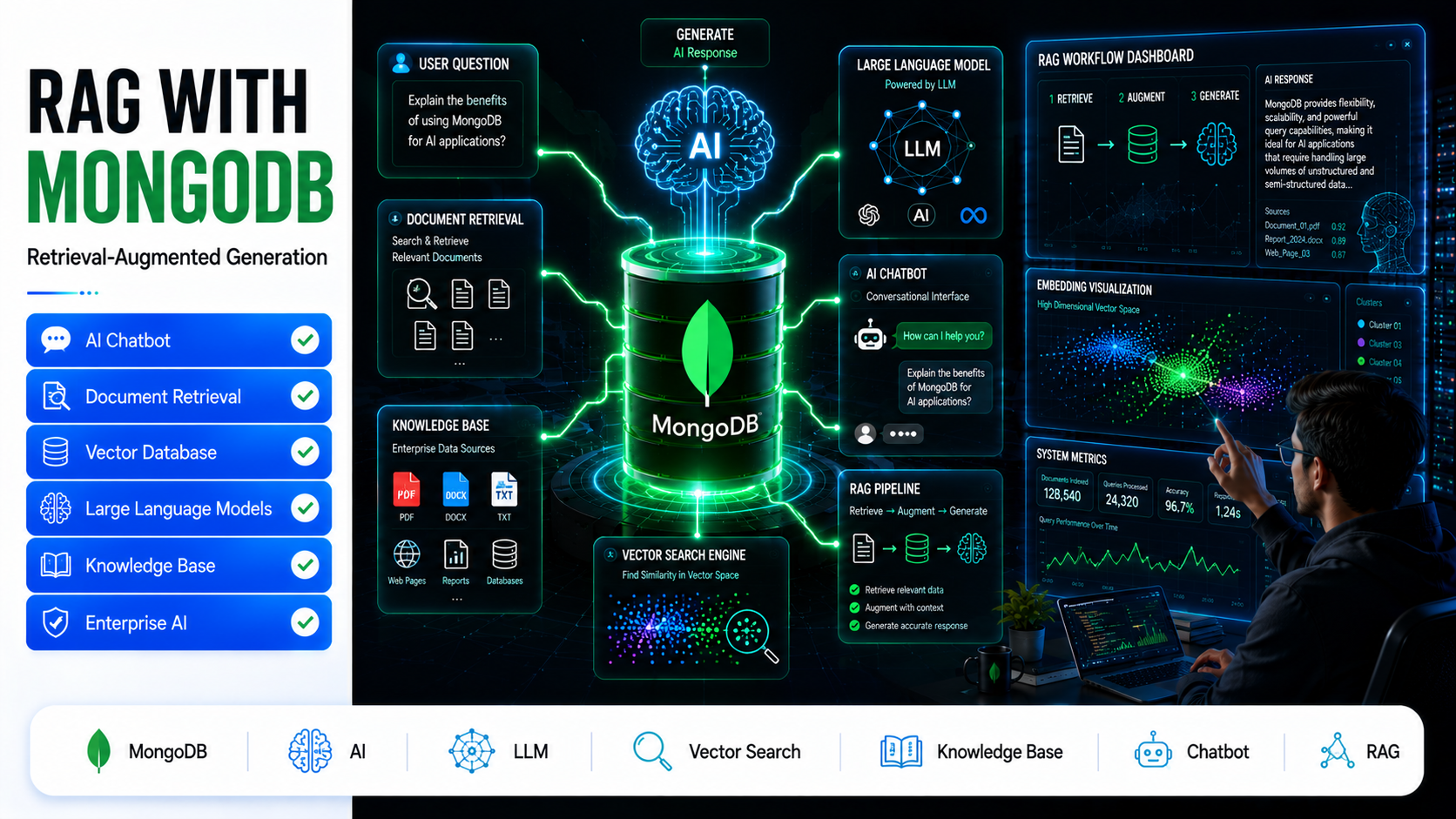
Rather than expecting an AI model to memorize every piece of information, RAG allows it to retrieve relevant knowledge from a trusted data source before generating a response. In this course, MongoDB becomes that trusted knowledge source.
Imagine building an AI-powered customer support chatbot for an e-commerce company. Customers ask questions about shipping policies, refund procedures, warranty information, or product specifications. Instead of relying on outdated training data, the chatbot first searches MongoDB for the most relevant documents. Those documents are then supplied to the language model, which generates an accurate and context-aware response.
This retrieval process makes AI significantly more reliable because the model answers based on current information rather than assumptions.
MongoDB plays a central role in modern RAG architectures because it combines document storage with Vector Search capabilities. The workflow begins by storing business documents, PDFs, FAQs, manuals, or knowledge articles inside MongoDB. These documents are converted into vector embeddings using an embedding model, allowing them to be searched based on semantic meaning rather than exact keywords.
When a user submits a question, the application converts the query into another vector and performs a similarity search. MongoDB identifies the most relevant documents, and those results are passed to the language model as additional context. Finally, the model generates a response grounded in the retrieved information.
This approach offers several important advantages. Responses become more accurate because they’re based on verified company data. Since the database can be updated at any time, the AI always has access to the latest information without requiring the model to be retrained. It also helps reduce hallucinations, where language models confidently produce incorrect answers, because the generated response is supported by real documents.
RAG has quickly become a standard architecture for enterprise AI applications. Organizations use it to build intelligent search systems, legal research assistants, medical knowledge platforms, financial advisory tools, educational tutors, and internal documentation assistants. Any application that depends on reliable, up-to-date information can benefit from combining MongoDB with Retrieval-Augmented Generation.
It’s important to understand that RAG isn’t just another AI trend—it’s a practical solution for making language models genuinely useful in real-world business environments. Learning how MongoDB supports vector storage, semantic search, and document retrieval prepares developers to build AI systems that are not only intelligent but also trustworthy and scalable.
By the end of this module, you’ll understand how traditional databases and modern artificial intelligence work together, giving you the foundation to create next-generation applications that deliver accurate, context-aware experiences.
Skills You’ll Gain
Completing this course provides far more than theoretical knowledge. You’ll develop practical skills that are directly applicable to modern software development and AI-powered applications.
By the end of the course, you’ll be able to:
- Understand MongoDB’s document-oriented architecture and how it differs from relational databases.
- Design scalable database schemas using industry-recognized patterns while avoiding common anti-patterns.
- Build efficient CRUD operations for real-world applications.
- Optimize database performance through effective indexing strategies.
- Understand vector embeddings and semantic search concepts.
- Implement MongoDB Vector Search for AI-driven search experiences.
- Build Retrieval-Augmented Generation (RAG) pipelines using MongoDB as the knowledge source.
- Make informed decisions about when MongoDB is the right database for a project and when a relational database may be a better fit.
These skills are increasingly valuable as organizations adopt cloud-native architectures and AI-powered products.
Career Opportunities After Learning MongoDB
MongoDB has become one of the most widely used NoSQL databases across startups, enterprises, and cloud platforms. As a result, professionals with practical MongoDB experience are in high demand across multiple industries.
After completing this course, you’ll have a strong foundation for roles such as:
- Backend Developer
- Full-Stack Developer
- Database Developer
- NoSQL Database Engineer
- Cloud Application Developer
- Data Engineer
- AI Application Developer
- Machine Learning Engineer (working with RAG systems)
- DevOps Engineer
- Solutions Architect

MongoDB is commonly integrated with technologies like Node.js, Python, Java, .NET, Go, React, and cloud services such as AWS, Microsoft Azure, and Google Cloud. Understanding how MongoDB fits into these ecosystems significantly expands your career opportunities.
As businesses increasingly invest in generative AI, professionals who understand both databases and AI workflows are becoming especially valuable. Skills like Vector Search and RAG are now appearing in job descriptions that previously focused only on traditional backend development.
7 Best NAS Storage Device in India
Frequently Asked Questions
Is MongoDB suitable for beginners?
Yes. MongoDB is often considered one of the easiest modern databases to learn because its document structure closely resembles JSON, a format that many developers already use. This makes it easier to understand and work with compared to more rigid relational database models.
Do I need SQL knowledge before learning MongoDB?
No. While familiarity with SQL concepts can be helpful, it’s not required. This course explains the differences between relational databases and MongoDB, making it suitable for learners from both SQL and non-SQL backgrounds.
Can MongoDB handle large-scale applications?
Absolutely. MongoDB is designed with scalability in mind and is used by organizations that manage millions of users and massive amounts of data. Features like replication, sharding, and indexing make it well-suited for high-performance production environments.
Why is Vector Search important?
Traditional keyword searches only find exact matches, whereas Vector Search understands the meaning behind text. This enables applications to deliver more relevant search results, recommendations, and AI-driven experiences.
What is the benefit of learning RAG with MongoDB?
RAG allows AI systems to retrieve current and reliable information before generating responses. By using MongoDB as the retrieval layer, developers can build intelligent applications that are more accurate, context-aware, and easier to maintain.
Conclusion
MongoDB has evolved far beyond being just another NoSQL database. It has become a comprehensive data platform capable of supporting traditional web applications, cloud-native services, real-time analytics, and modern AI-powered solutions.
Throughout this course, you’ve explored the core principles that make MongoDB unique—from understanding document-based data models and designing efficient schemas to performing CRUD operations and optimizing performance with indexes. These foundational concepts prepare you to build scalable, maintainable applications that can adapt as business requirements evolve.
The course also introduces technologies shaping the future of software development. By learning Vector Search and Retrieval-Augmented Generation (RAG), you’ve gained insight into how modern databases integrate with artificial intelligence to create applications that understand context, retrieve meaningful information, and deliver more accurate responses.
Whether your goal is to become a backend developer, build cloud-native applications, or create intelligent AI solutions, the knowledge covered in this course provides a strong foundation. As technology continues to evolve, developers who can combine reliable database design with AI-driven capabilities will be well-positioned to solve increasingly complex problems and contribute to the next generation of software innovation.
Learning MongoDB is not simply about mastering a database—it’s about understanding how data powers modern applications and how that data can be transformed into meaningful, intelligent experiences. By applying the concepts covered in this course through real-world projects and continuous practice, you’ll be well-equipped to build scalable applications that meet the demands of today’s technology landscape and tomorrow’s innovations.
Thank you for taking the time to complete this course. We hope it has helped you build a strong understanding of MongoDB, from its core fundamentals to advanced AI-powered applications like Vector Search and Retrieval-Augmented Generation (RAG). Keep practicing, keep building, and continue exploring new technologies. Wishing you success in your learning journey and future projects!